Auto-Generate YouTube Chapter Markers from Subtitles (2026 Guide): Build 6-10 High-Retention Chapters in 5 Minutes

You uploaded a 45-minute podcast interview to YouTube. The title is sharp, the thumbnail is polished. Forty-eight hours later, the analytics dashboard tells a familiar story — average view duration 4 minutes 30 seconds, completion rate 11%. The top channels in the same vertical clock 18-minute average views at 38% completion. That’s a 3-4x gap.
The gap has many sources, but one underrated factor is chapter markers (YouTube calls them Chapters, Bilibili calls them “time stamps”). Videos with chapters get tagged as “structured content” by the YouTube algorithm. The chapter slices on the progress bar themselves act as a preview-and-scrub UI, letting viewers “browse before they decide” — a psychological pathway that multiplies both completion rate and total watch time.
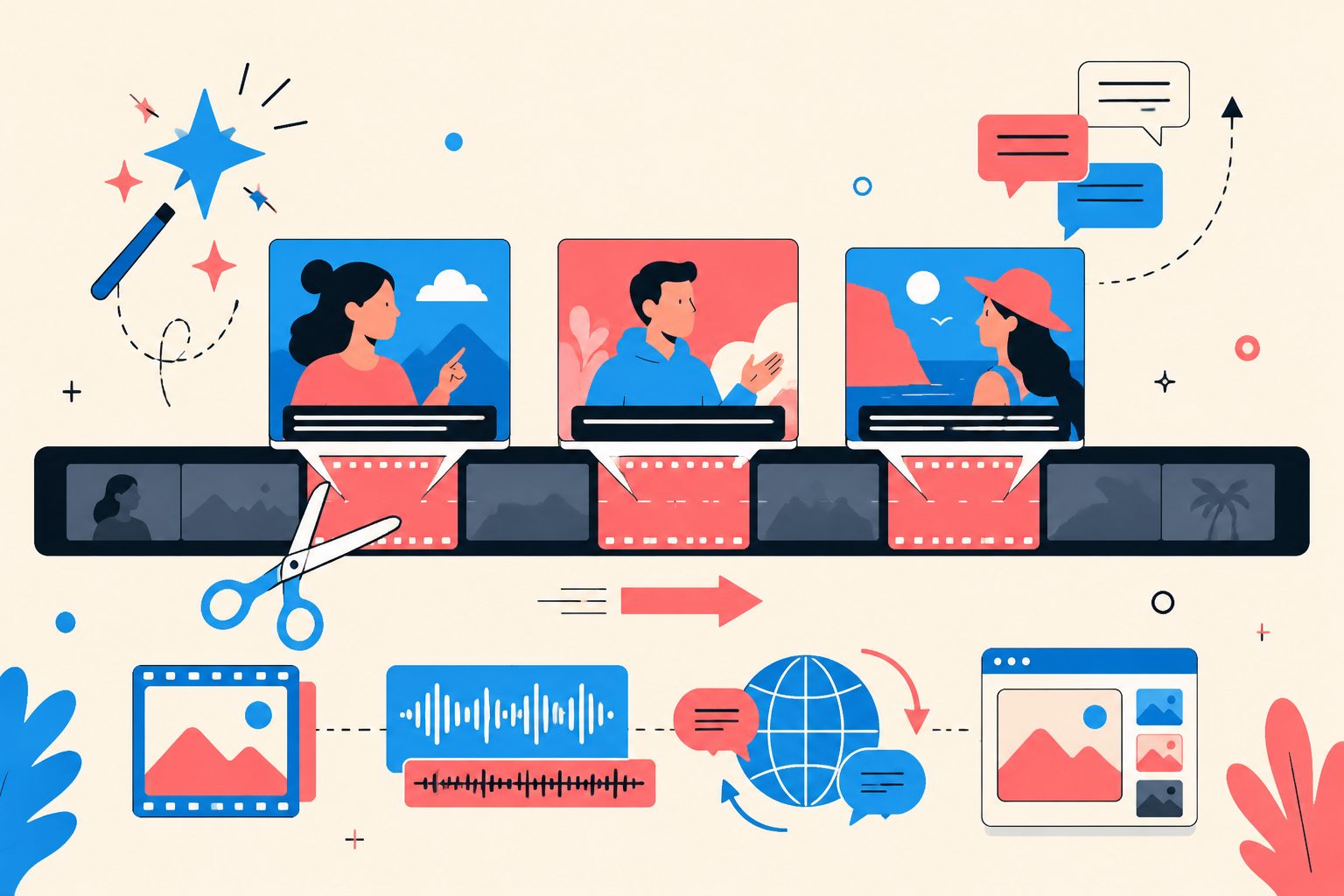
The practical bottleneck: hand-writing chapters is slow and tedious. A 45-minute video takes 1.5+ playthroughs to produce 8 quality chapter titles, costing 30-45 minutes per upload. This guide walks through the alternative — using AI subtitles to reverse-engineer the chapter structure, turning a 45-minute video into 6-10 semantically rich chapter markers in 5 minutes.
TL;DR: The 4-Step Subtitle-Driven Chapter Automation Workflow
| Step | Input | Output | Time |
|---|---|---|---|
| 1. Extract subtitles | Raw video file or YouTube/Bilibili URL | Timestamped full-text subtitles (SRT or VTT) | 2-5 min (length-dependent) |
| 2. Semantic segmentation | SRT subtitles | 6-10 topic blocks (~3-8 min each) | 1 min (AI automatic) |
| 3. Chapter title generation | Text snippet per block | Chapter title (4-8 words, with a hook) | 30 sec (AI automatic) |
| 4. Format + publish | Chapter list | Time-coded text ready to paste into YouTube description | Instant |
Practical rule: The point of chapter markers isn’t “segmentation” — it’s “turning the progress bar into a table of contents,” so viewers can tell at a glance whether the video is worth their time.
Why Long Videos in 2026 Must Ship with Chapters
YouTube’s Implicit Algorithmic Preference for Chapters
YouTube’s Creator Insider channel has hinted at “video structural signals” multiple times across 2025. Chaptered videos get tagged as “more viewer-friendly,” gaining 8-15% more impressions in both “Up Next” recommendations and homepage browse surfaces (per TubeBuddy’s 2026 Q1 report sample analysis).
The more direct impact is watch time. Chapters let viewers skip past sections that don’t interest them and jump to the core content. Counter-intuitively, this increases watch time — viewers who jump to a section they like watch it through, instead of closing the video after 30 seconds of “this isn’t what I expected.”
Bilibili’s Dual Mechanism: Parts + Time Stamps
Bilibili’s content ecosystem leans heavier into long-form than YouTube — videos over 30 minutes make up a much larger share. Bilibili calls its chapter analog “time stamps” (timecodes in the video description are auto-recognized as clickable jumps). Top Bilibili creators (老蒋巨靠谱, 罗翔说刑法, others) ship 5-10 time stamps on virtually every 20-minute-plus video.
Practical rule: YouTube chapter format and Bilibili time-stamp format differ slightly in syntax, but the content structure is fully reusable — extract once, publish to both.
The Hidden Cost of Skipping Chapters
A 45-minute video without chapters forces viewers to make a “stay or leave” decision in the first 30 seconds. The default outcome of that decision is “leave” — because they have no signal indicating whether the rest of the video gets more interesting. Chapter markers are a table of contents that flips the question from “should I stay 30 seconds longer?” to “where do I want to start?”
Step 1: Extract High-Quality Subtitles from the Raw Video
Subtitle quality determines the ceiling for every downstream step. If the subtitles get names, jargon, and code-switched language wrong, the AI segmentation collapses too.
Three Paths to Get Subtitles
Path A — CutFast one-click transcription: Upload the video file, get timestamped bilingual (Chinese + English) subtitles. Accuracy holds steady above 95% on Mandarin and English content. Long interviews, podcasts, and tutorial recordings all work directly.
Path B — YouTube auto-caption export: Videos already published to YouTube can have captions exported, but YouTube’s auto-captions hit only 70-80% accuracy on Mandarin. Specialist content (medical, legal, technical) usually needs manual correction.
Path C — Local Whisper Large-v3: Self-host Whisper Large-v3. Accuracy approaches CutFast’s, but you need a local GPU or cloud compute. A 1-hour video takes 8-15 minutes end-to-end.
Subtitle Quality Checklist
Run through these 3 checks before moving on:
- Proper nouns are correct: guest names, jargon, brand names, place names spelled right
- Timestamp precision is sufficient: each subtitle row has second-level timestamps (HH:MM:SS), not minute-level
- No structural gaps: no missing or duplicated stretches (Whisper occasionally hallucinates content in silent passages)
Step 2: Use AI for Semantic Segmentation (the Core of Chapter Automation)
After getting subtitles, the next step splits them into “topic-independent” blocks. This is the core of the pipeline — split well, and chapter titles write themselves; split poorly, and titles devolve into meaningless “First 5 minutes / 5-10 minutes” labels.
Three Rules for Semantic Segmentation
Rule 1: Use topic transitions as segmentation boundaries.
The “topic switch signals” you hear in audio — “next let’s talk about…”, “okay let me switch angles…”, “quick aside…” — are detectable by AI from the subtitle text. These transition cues are natural segmentation boundaries.
Rule 2: Keep each segment 3-8 minutes long.
Segments under 2 minutes don’t carry enough information density — the chapter titles feel weightless. Segments over 10 minutes lose focus when viewers jump in mid-stream. 3-8 minutes is the sweet spot where viewers willingly watch a full chapter.
Rule 3: 6-10 chapters is YouTube’s sweet spot.
YouTube requires a minimum of 3 chapters and allows up to ~30. But the data shows 6-10 chaptered videos get the highest “chapter slice click-through rate” — viewers can scan the full TOC at a glance and still have enough entry points.
Using CutFast’s Built-In Semantic Segmentation
CutFast runs a semantic-segmentation pass automatically after subtitle generation. It reads the full subtitle text, detects topic transition points, and outputs 6-10 candidate segments — each with start/end timestamps and a text summary. Fully automatic — no need to listen through the whole video.
If you’re not using CutFast, you can paste the subtitle into ChatGPT / Claude and ask for the same operation — but the quality is directly tied to the model’s comprehension. Lower-tier models (GPT-3.5 class) often merge two distinct topics or split a single topic into three odd fragments.
Practical rule: Semantic segmentation determines 80% of downstream chapter quality. Don’t shortcut this step.
Step 3: Write High-Hook Chapter Titles for Each Segment
Once segments are settled, the next step is writing a title for each. This is the step most prone to “phoning it in and producing dead weight.”
Four Traits of a High-Hook Chapter Title
| Trait | Bad example | Good example |
|---|---|---|
| Concrete numbers | “On product philosophy” | “Why we shipped 3 major rewrites” |
| Conflict | “On entrepreneurship” | “The 5 wrong calls — each cost us dearly” |
| Outcome-driven | “On team management” | “Growing from 3 to 30 people: the hardest step” |
| 4-8 words | “At minute 27 I discuss product positioning” | “Three pivots on product positioning” |
Two Ways to Generate Chapter Titles
Method 1 — Let an AI write the first draft: feed each segment’s text summary to GPT-4 / Claude 3.5 / Gemini 2.5 with a prompt like “Write a 4-8 word chapter title for the following podcast segment. Require concrete numbers, conflict, or outcome framing.” Initial AI drafts are 60-70% usable; light editing fixes the rest.
Method 2 — Use CutFast’s built-in chapter title generator: CutFast runs chapter title generation after semantic segmentation. The output is already optimized for YouTube/Bilibili expression conventions in both English and Chinese. Paste directly into the YouTube description.
Anti-Pattern: Chapter Titles Nobody Clicks
00:00 Intro
04:32 Part One
12:18 Part Two
22:45 Part Three
35:00 Conclusion
“Intro / Part One / Conclusion” titles are essentially no titles at all — viewers skim them and learn nothing, so they’re functionally equivalent to no chapters.
Step 4: Format Output + Dual-Platform Publishing
The final step is converting the chapter list into formats both YouTube and Bilibili recognize.
YouTube Chapter Format
YouTube requires the first timestamp be 00:00, a minimum of 3 chapters, and each chapter at least 10 seconds long:
00:00 What this video is about
01:30 Guest background and first startup
08:45 Five wrong calls that cost us dearly
17:20 Growing from 3 to 30 people
26:00 Three pivots on product positioning
35:15 The most important thing for the next 12 months
42:00 Three pieces of advice for young founders
Paste this block at the start of the YouTube video description. YouTube auto-detects it as chapter data and renders the slices on the progress bar.
Bilibili Time-Stamp Format
Bilibili’s format is slightly different — timecodes accept MM:SS or HH:MM:SS, and no 00:00 starter is needed:
01:30 Guest background and first startup
08:45 Five wrong calls that cost us dearly
17:20 Growing from 3 to 30 people
26:00 Three pivots on product positioning
35:15 The most important thing for the next 12 months
42:00 Three pieces of advice for young founders
Paste into the Bilibili upload description field.
Chapter Thumbnails (Optional)
YouTube opened “chapter thumbnails” in Q4 2025 — you can upload a separate thumbnail per chapter. Eligibility: channel with ≥1000 subscribers + completed creator verification. If you’re eligible, ship a thumbnail per chapter — per YouTube’s 2025 Year on YouTube report, videos with chapter thumbnails see a 5-8% lift in click-through over plain-text-chapter videos.
Practical rule: Chapter markers are SEO. Chapter thumbnails are CRO. One solves “can they find me,” the other solves “will they click.”
Frequently Asked Questions
Q1: Can I add chapters after the video is already published?
Yes. Both YouTube and Bilibili let you edit the description post-publish. The algorithm re-crawls and updates within 1-2 hours. But if the video has been live for more than 7 days and engagement data has stabilized, the lift from added chapters is smaller than “publishing with chapters from day one” — the algorithm has already scored the video.
Q2: Does this method work for English content (like English podcasts)?
Yes — the method is language-agnostic. The only difference is in Step 1 subtitle extraction. For English content, use CutFast or another high-accuracy speech-to-text tool — English accuracy runs slightly higher than Mandarin. In Step 3, English chapter titles target 4-8 words.
Q3: Does it work for live-stream replays (Twitch, Bilibili live archives)?
Live replays are even better candidates for chapters than recorded uploads — a 3-4 hour stream with no chapters won’t get re-watched at all. The full workflow is covered in CutFast’s live-stream-to-clips guide.
Q4: Should short videos have chapters too?
Short videos (under 10 minutes) shouldn’t have chapters — YouTube’s chapter slices are nearly invisible on small screens for short content, and the crowded progress bar actually hurts the experience. 10 minutes is the cutoff; below that, skip chapters.
Q5: Should chapter titles include emojis?
You can add one emoji (at the start of a chapter), but not on every chapter. Emojis work as visual anchors — pick the first chapter and the most important chapter, drop one emoji each, and you’re done.
Next Step: Make Chapter Automation a Daily Workflow
By now it should be clear: chapter markers aren’t “spend 30 minutes hand-writing before publish” — they’re “auto-generate 5 minutes after upload.” Bake this into your SOP and you can ship 2-3 more chaptered videos per week.
A practical workflow:
- Finish recording → upload directly to CutFast (don’t edit first)
- CutFast auto-transcribes subtitles + runs semantic segmentation + generates chapter titles (5-8 min)
- Export chapter time codes → paste into YouTube/Bilibili description
- Simultaneously export 9:16 vertical clips → distribute to TikTok / Reels / Shorts
- One long video, five distribution outputs, one subtitle pass, one chapter list, one workflow
If you’re shipping two or more long videos per week, this saves 3-5 hours of human time per week. Try CutFast’s free quota — run a recent video through it and inspect the chapter output yourself.
CutFast Team
More in this series
- Free AI Text-to-Speech 2026: Generate Studio-Quality Voiceover in 30 Seconds (40+ Languages, 100+ Voices, Commercial Use)
- Subtitle Burner 2026: Hardcode SRT into Video for TikTok / Reels / Douyin / Bilibili (Free Browser Tool, No FFmpeg)
- Short-Video Subtitle Emphasis Styling 2026: 3 Parameter Sets for Keyword Highlights, Bounce Words, and Word-Level Emphasis + CutFast One-Click Apply
- Online SRT to MP4 Subtitle Burning 2026 Guide: 4 No-Install Tools Compared, Ship in 5 Minutes
- Online Auto Subtitle Burner Tools 2026: 5-Way Comparison + CutFast One-Click Workflow
View all 14 articles in Subtitles & Captions →