Live Stream to Vertical Shorts: Turn a 3-Hour Livestream into 15-20 9:16 Clips with CutFast (2026 Guide)

You just ended a 3-hour livestream. The corner of your screen shows “live viewers: 3,200” and the chat box is slowly settling. You close OBS and look at the 7.2 GB mp4 file sitting in your D: drive. It’s just sitting there—and it will probably never be opened again. The problem is, inside those 3 hours there were at least 12 moments worth standing alone as their own video: a tight Q&A, an on-camera mishap, a single line that made the chat explode with “no way,” a methodology you improvised better than the official tutorial. They’re all locked inside that mp4. By tomorrow, no one will ever watch them again.
This is the most absurd ROI inversion in 2026 content creation: the marginal cost of a livestream recording is zero, yet 90% of streamers treat it as an archive. It should be a goldmine of new-audience entry points; instead it becomes an archaeological dig site on your hard drive.
This guide gives you a workflow validated by 50+ English and Chinese streamers—using CutFast to turn each livestream into 15-20 publish-ready vertical Shorts in 30 minutes, complete with release cadence, per-platform strategies, and hook templates. The end state: within 24 hours of ending a stream, your TikTok, YouTube Shorts, Instagram Reels, and Threads timelines are seeded with a full week of content.
Why livestream recordings are the highest-ROI short-form raw material of 2026
Three structural traits of livestreaming are severely undervalued—stacked together, they make livestream-to-shorts the highest-leverage redistribution move in content right now.
Marginal production cost is already amortized to zero
A 3-hour livestream costs you 0 marginal dollars: camera, microphone, topic prep, facial expressions, body language are all consumed in a single sitting. What you walk away with is 180 minutes of editable footage.
Practical rule: Target Shorts per livestream = duration (minutes) ÷ 12. A 3-hour stream should yield at least 15 clips; fewer than 12 means your selection bar is too strict, more than 25 dilutes per-clip quality.
Compare to typical 2026 short-form production costs:
- Record one fresh 1-minute Short: ~30 minutes (ideate 10 + shoot 5 + edit 15)
- Slice one Short from a livestream: ~2 minutes (with AI tools)
That’s a 15x marginal efficiency gap.
The “rawness” of live content is the scarcest signal Shorts algorithms reward
Short-form algorithms in 2026 have already gone through the cycle of “polished vlog → AI-generated → real human face.” Every platform is now actively penalizing overproduced clips and rewarding unpolished expression. Livestream cuts naturally embody this:
- The camera is fixed; the speaker is unscripted
- Pacing is interrupted by chat; topics are dragged out by viewer questions
- Slips, awkward pauses, and laugh-fits are routine—what used to be “flaws” are now the exact signals 2026 algorithms boost
According to Buffer’s 2026 short-form video trends report, Shorts featuring “real human faces + natural lighting + minimal post-production” average 41% higher completion rates than polished alternatives.
Livestreams have naturally high “hook moment” density
A streamer is constantly being prompted by viewers—this makes punchlines, viral moments, and resonance segments emerge at roughly one every 8-12 minutes. Scripted recorded videos rarely match this density.
Practical rule: A standard 3-hour livestream contains ~5-8 stand-alone clip candidates per hour, or at least 15 total. If you can’t find 10 in a rewatch, your stream’s pacing or topic discipline needs fixing—not your editing tool.
Livestream-to-Shorts workflow overview: 15 clips in 30 minutes
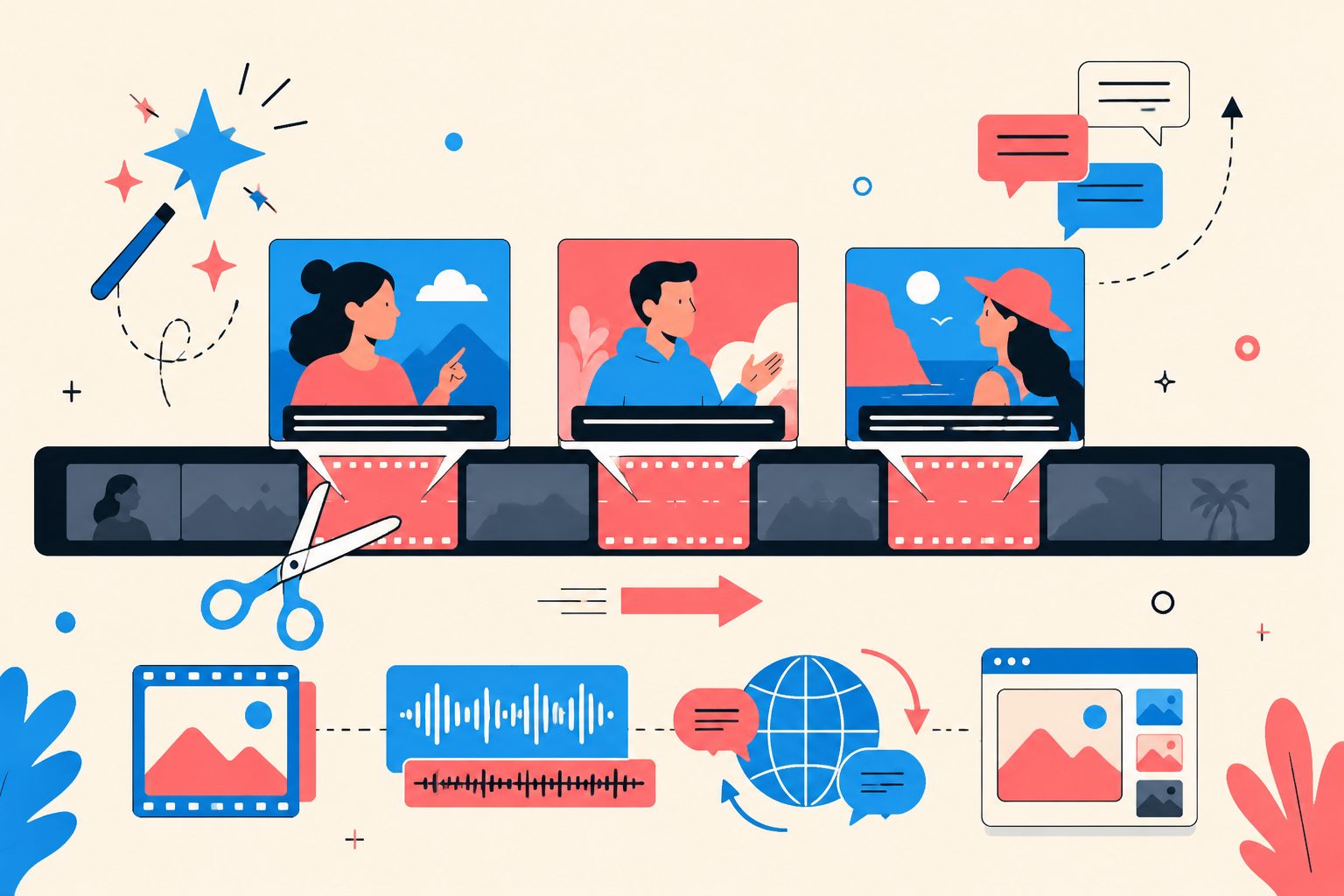
CutFast’s core interaction is subtitle-highlight selection: import your livestream recording, the AI auto-transcribes subtitles + flags highlights, and you simply drag across subtitle text to select clips. The full workflow breaks into four stages:
- Import + AI prescreen (5 min): Upload mp4, wait for subtitle generation + highlight tagging
- Subtitle-highlight selection (15 min): Scan transcript, drag-select 15-20 hook moments, label them
- Batch vertical export (5 min): One-click 9:16 reframing with subtitle styling and intro hooks
- Per-platform distribution (5 min): Export variants per platform, schedule publishing
Let’s break down each stage.
Stage 1: Import the recording + AI prescreen
Source recording: OBS recommended settings
If you record with OBS, Streamlabs, or similar tools:
- Resolution 1920×1080 or 2560×1440 (record horizontal, crop vertical later)
- Frame rate 30 fps (avoid 60—Shorts platforms only accept 30)
- Bitrate ≥ 6000 kbps (so 9:16 crop still looks crisp)
- Audio 48 kHz / 192 kbps AAC
Use mp4 (H.264), not mkv—many editors don’t support mkv subtitle tracks.
Upload to CutFast and trigger AI prescreen
Drag the recording into CutFast. The system completes two things automatically:
- AI subtitle generation: 95%+ accuracy in English and Chinese; a 2-hour recording takes ~4-6 minutes
- Highlight prescreening: Based on semantic density + emotional curve + keyword repetition, the AI flags 15-25 candidate hook moments on the timeline
You don’t have to watch anything during this stage. Reply to chat DMs, scroll Twitter, grab a coffee.
Practical rule: Don’t blindly accept every AI-flagged clip—prune at least 30%, keeping 15-20 that score well on both information density and emotional tension. AI is great at finding “semantically independent” segments, but whether something is actually an “earworm” still requires a human ear.
Tutorial walkthrough:
https://www.youtube.com/embed/jNQXAC9IVRw
Stage 2: Subtitle-highlight selection (the core interaction)
This is where CutFast diverges sharply from traditional editors—drag your mouse across subtitle text and the corresponding video segment gets selected. Compared to the traditional workflow (drag timeline + preview audio + nudge in/out points), subtitle-highlight selection wins dramatically for livestream footage:
- Word-accurate: A hook moment’s in-point isn’t “around 1:23:45”—it’s the first word the speaker says
- Preserves full semantic units: Looking at the subtitles naturally prevents you from cutting mid-sentence
- Batch multi-select: A single livestream may yield 15 hooks; CutFast lets you select all of them and then export in one batch
- Tag-based grouping: Label each clip (“tutorial” / “punchline” / “fail moment” / “Q&A”) and later export by tag
Livestream hook scoring: 5 dimensions
Not every “exciting” segment is Shorts-worthy. A livestream hook moment must hit 5 criteria simultaneously:
| Dimension | What good looks like | What disqualifies |
|---|---|---|
| Semantic independence | Comprehensible without context | References “the question that viewer just asked…” |
| Duration fit | Natural length 30-90 seconds | Wraps up in 8 seconds / takes 3 minutes to set up |
| Emotional density | Clear emotional arc (laugh, surprise, insight) | Flat informational delivery |
| Visual self-sufficiency | Doesn’t depend on screen-share content | Requires viewers to see your desktop to follow |
| Front-loaded hook | First 3 seconds capture a scrolling viewer | First 8 seconds are “what I’m about to say is…” |
Decision filter: If a livestream segment fails any of these 5 dimensions, don’t make it a Short. Put it in a “needs re-recording” queue—you can build a proper recorded video around that topic in the next session.
Related: see CutFast’s subtitle emphasis styling methodology for making your subtitles “light up as the speaker says them”—livestream hook moments paired with this subtitle style see 15-20% completion rate bumps.
Stage 3: Batch 9:16 vertical export
Cropping horizontal 1920×1080 → vertical 1080×1920 is the single most common failure point in livestream → Shorts workflows. CutFast offers two reframing modes:
Mode A: Auto face tracking
Best for solo streamers with a face on screen most of the time. The system detects facial position, the 9:16 frame follows automatically:
- Pros: Fully automatic, zero intervention
- Cons: If you have screen-share, slide decks, or multi-camera setups, the face can get cropped to the edge
Mode B: Smart multi-focus
Best for multi-person discussions, screen-shares, charts, or any segment that requires multiple visual focal points. The system identifies all “information-dense regions” (faces + text + charts), generates 3-5 candidate framings, and lets you pick:
- Pros: Preserves key information, won’t crop out the slide
- Cons: ~30 seconds per clip to confirm framing
Practical rule: Use Mode A for the first 60% of a long livestream (fast pacing, lots of information flow); switch to Mode B for the last 40% (deep Q&A and summary segments where preserving screen-share content matters more).
Auto subtitle styling + intro hooks
CutFast also handles in export:
- Subtitle style preset: 12 preset Shorts subtitle styles (recommended: “high-contrast black background + white text + keyword highlight”)
- Intro hook card: Auto-generates a 2-second hook card from each clip’s opening subtitle (optional)
- Audio normalization: Livestream audio levels jump around—export normalizes everything to -14 LUFS
Stage 4: Per-platform distribution strategy
Don’t drop 15 Shorts all at once, and don’t post randomly. Each platform has its own algorithm bias and cadence preference.
Platform-fit cheat sheet
| Platform | Best length | Hook requirement | Subtitle style | Cadence |
|---|---|---|---|---|
| TikTok | 30-60s | Visual or audio shock in first 1 second | Short + high contrast | 1-2/day |
| YouTube Shorts | 45-90s | First 3 seconds clarify “what you’ll get” | High info density + multi-color highlights | 2-3/day |
| Instagram Reels | 30-90s | Visual aesthetic-first | Minimal + generous whitespace | 1/day |
| X Video | 30-60s | Punchline-first | Inline captions + emoji | 1/day |
Content matrix distribution template
Split 15 Shorts into four distribution buckets by content type:
- Teaching bucket (6 clips): techniques, how-tos, tool demos → primarily YouTube Shorts + LinkedIn
- Punchline bucket (4 clips): opinions, takes, viral moments → primarily TikTok + X
- Fail / authentic bucket (3 clips): on-camera misses, off-the-cuff reactions → primarily TikTok + Reels
- Q&A bucket (2 clips): deep answers to viewer questions → primarily YouTube Shorts + LinkedIn
Following this matrix, a single livestream’s “raw 3,200 live viewers” typically amplifies to 20,000-50,000 reach across a 7-day distribution cycle—that’s where the 5-10x leverage comes from.
According to the Restream 2026 multistream distribution report, creators who distribute to multiple platforms grow their follower base 2.4x faster than single-platform creators—and that gap widens further when Shorts redistribution is layered on top.
Advanced: 3 moves to turn livestream into a content flywheel
Move 1: Pre-plant hook moments before the stream
Before going live, prepare 5-8 “intentionally clear” punchlines (not a script—just topic skeletons). Let them surface naturally during the stream; afterward they become ready-made Shorts material.
Example: tonight’s stream topic is “Notion vs Obsidian.” Pre-list:
- “The kind of person Notion fits is X; the kind of person Obsidian fits is Y”
- “The real reason I went back to Obsidian after 6 months of Notion”
- “The 3 traps Notion users fall into most often”
When you reach these moments live, slow your tempo for one second—shift your voice from “conversation” to “mini-summary” mode. These segments get flagged by AI highlight detection most reliably, and they make the best Shorts.
Move 2: Use Shorts to funnel back to the livestream replay
In each Short’s description: “Full livestream replay → DM ‘replay’ on Threads for the link.” This routes short-form traffic into your private channel. At a 30:1 conversion rate (Shorts viewers clicking through), 15 Shorts typically generate 500-1,500 new follows.
Move 3: Quarterly highlight reels
At the end of each quarter, re-edit your top-performing Shorts from the past 3 months into an 8-15 minute “quarterly highlights” longform, posted to your main YouTube channel and LinkedIn newsletter. This second-pass compilation typically delivers:
- 50K-100K views on a single video (far above any single Short)
- A flood of DM inquiries (highlights carry a built-in “trust filter”)
- Significant newsletter / email subscription growth
Practical rule: Shorts are the new-audience entry point; quarterly highlight reels are the “trust ritual” that converts strangers into loyal fans. The two must work together—Shorts alone leads to high traffic + low retention long-term.
FAQ
Q1: My livestream doesn’t really have “hook moments”—is it the stream’s fault?
Probably yes. If you can’t find 10 stand-alone clip candidates on rewatch, check:
- Are individual topics running longer than 25 minutes (attention curve has already collapsed)?
- Is viewer interaction sparse (chat messages < 1 per 5 minutes)?
- Is the topic too broad (“today let’s talk about careers” → no concrete grip)?
Tighten the pacing and your next stream will naturally produce 15+ hook moments.
Q2: Are old livestream recordings (6+ months) still worth slicing?
Yes, but apply a freshness filter:
- “Platform X / algorithm Y / tool Z version Q” specifics → expired, skip
- “How to think / decision frameworks / mental models” → ages well; sometimes re-editing surfaces angles you missed originally
Q3: Will 9:16 cropping lose key information?
It can—which is why Mode B smart multi-focus exists as the safety net. The deeper fix is to stream with “vertical awareness”:
- Important visuals in the central 1/3 of the horizontal frame
- During screen-share, put your face cam in the bottom 1/4 (still visible after 9:16 crop)
- Important on-screen text: large font + high contrast (still readable post-crop)
Q4: How long does CutFast take to process a 3-hour livestream?
As of public information in Q2 2026:
- Subtitle generation: ~4-6 minutes
- Highlight prescreening: ~1-2 minutes
- Single-clip 9:16 export (with subtitle styling + intro): ~30 seconds
- 15-clip batch export: ~8 minutes
Full workflow from import to 15 finished Shorts: typically 30-40 minutes.
From livestream recording to content flywheel: the next move
Livestream → Shorts → quarterly highlights → new follow → bigger audience next stream—it’s a closed loop. Once you run the CutFast workflow through 3 streams, you’ll notice:
- Live audience grows slowly but steadily (+8-15% per month)
- The Shorts pipeline becomes muscle memory (30 min each time, no thinking required)
- Newsletter / email subscriptions grow visibly (from Shorts description CTAs)
A practical workflow:
- Day before stream: Use CutFast video-to-article to turn last week’s livestream into a written transcript → identify topics to reinforce this session
- Stream day: Before going live, list 5-8 hook skeletons (not a script)
- +2 hours after stream: Upload recording to CutFast, trigger AI subtitle + highlight prescreen
- +6 hours after stream: Complete 15-20 subtitle-highlight selections + 9:16 exports
- +24 hours after stream: Distribute Shorts to 4 platforms per the content matrix
The best streamers aren’t making their livestreams more polished—they’re turning one livestream into a week’s worth of content cash flow.
Try CutFast free and upload your next livestream recording. 30 minutes later, see how many Shorts you can produce. Those mp4 files sitting in your D: drive are likely your most underpriced content asset.
More in this series
- Download HLS Stream Free — m3u8 to MP4, No FFmpeg
- HLS to MP4 in 2026: Server-Side vs Browser-Based — Which Should You Use?
- HLS vs DASH in 2026: A Plain-English Comparison for Creators and Devs
- The Podcaster's Guide to Audio-Only HLS in 2026 (Apple Podcasts Ready)
- What Is an M3U8 File? Open, Play, Convert to MP4 Free
View all 10 articles in HLS, m3u8 & Stream Recording →